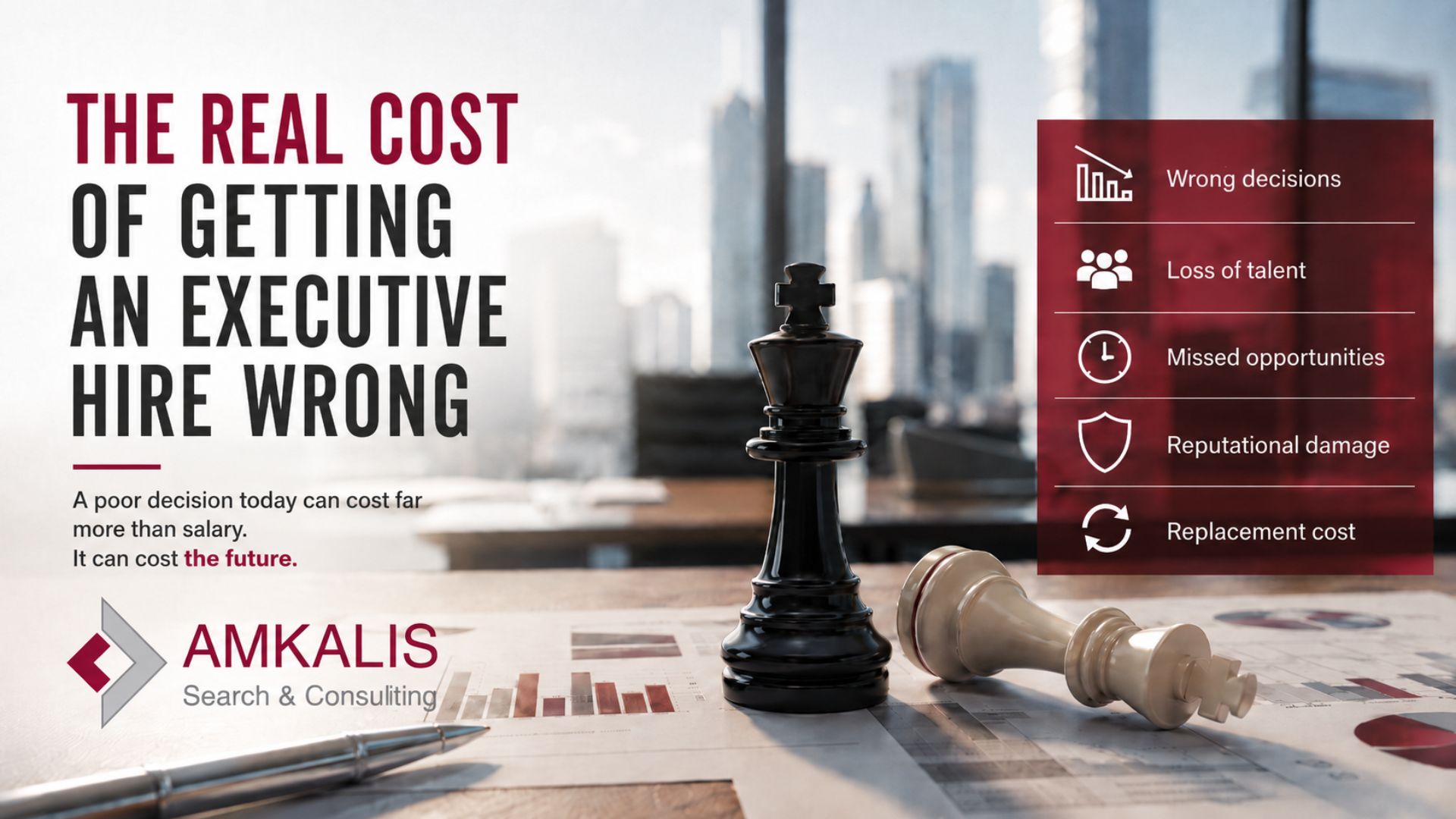
Getting an executive hire wrong is not simply expensive.
It is far more than that: it is strategic.
When a key leadership role is filled badly, the impact is not limited to salary, bonus, search fees or exit costs. Those are only the visible costs. The real cost appears later, when the organisation starts paying the price through delayed decisions, disoriented teams, weakened internal credibility, clients sensing instability and opportunities that do not return.
In today’s environment, hiring well has become even more critical. Recent labour market data points to clear employer caution: more temporary hiring, fewer permanent placements and slower hiring decisions. Economic uncertainty, rising costs and geopolitical pressure are pushing many companies to protect flexibility rather than commit to structural appointments.
And that is precisely why, when a company does decide to appoint a senior leader, it cannot afford to improvise.
A poor executive hire usually carries five hidden costs.
1. Direction cost
The wrong executive does not simply execute poorly.
They set the wrong priorities, misread the company’s situation and pull others into decisions that may take months to correct. At senior level, the impact of poor judgement is not measured only by what is done badly, but also by everything that is not done in time.
2. Team cost
Strong professionals do not leave only because of pay.
They leave when they lose confidence in leadership, when they perceive inconsistency or when they feel the project is losing clarity. A poor senior appointment can accelerate the departure of key talent or create a culture of waiting, self-protection and low commitment.
And when the team stops believing, the organisation stops moving forward.
3. Market cost
While the organisation adjusts to the new leader, competitors move ahead.
In sectors where technological transformation, margin pressure, artificial intelligence and new ways of working are redefining roles, six months of poor leadership can mean losing a strategic window.
The market does not wait for a company to correct a bad decision.
4. Reputational cost
At executive level, everything communicates.
The appointment communicates. The first messages communicate. The relationship with the board communicates. The team’s reaction communicates. And, if it happens, the exit communicates too.
A poor selection can signal weak judgement, urgency or governance fragility. And in an environment where corporate reputation is built — and damaged — at speed, choosing a leader is also a trust decision in front of employees, clients, investors and the market.
5. Replacement cost
Returning to the market does not mean starting again from zero.
It means doing so with less time, more pressure, greater exposure and, often, a more fatigued organisation. A second search is usually shaped by the previous failure: filters become harder, doubts become louder and risk tolerance becomes lower.
So the question is not how much it costs to run an executive search properly.
The right question is: how much could it cost not to do it properly?
In 2026, companies do not only need executives with a strong track record. They need leaders who can build trust quickly, make decisions with incomplete information, adapt the organisation to new scenarios and protect culture when conditions become difficult.
They also need more rigorous selection processes. Not necessarily longer, but better designed.
Define the mandate properly. Align expectations with the board and ownership. Assess capabilities, motivations, leadership style and cultural fit. Check references rigorously. Use data and technology without replacing expert judgement. And, above all, resist the temptation to confuse speed with effectiveness.
Because in executive hiring, the most available candidate is not always the right one.
And the most dangerous cost is not the one shown on the invoice. It is the one that takes months to become visible.
Sources
- AMKALIS – our accumulated experience over 17 years in Executive Search https://www.amkalis.com/
- Reuters — UK firms pause hiring as uncertainty weighs on recruitment
https://www.reuters.com/world/uk/uk-firms-pause-hiring-iran-war-stings-rec-survey-shows-2026-06-07/ (Reuters) - The Guardian — UK companies opting to hire temporary workers over permanent staff, recruitment firms say
https://www.theguardian.com/money/2026/jun/08/uk-companies-opting-to-hire-temporary-workers-over-permanent-staff-recruitment-firms-say (The Guardian) - Financial Times — UK employers hiring more temporary workers as staff costs rise
https://www.ft.com/content/5d352c7c-1cb7-4e9c-9a74-76a8e6b60684 (Financial Times) - REC — Report on Jobs: Temp billings increase at fastest rate in over three years, but permanent placements fall again in May
https://www.rec.uk.com/our-view/news/press-releases/report-jobs-temp-billings-increase-fastest-rate-over-three-years-permanent-placements-fall-again-may (The REC) - Russell Reynolds Associates — Global CEO Turnover Index
https://www.russellreynolds.com/en/insights/reports-surveys/global-ceo-turnover-index (russellreynolds.com) - Japan Intercultural Consulting — The Real Cost of Failed Executive Hiring
https://japanintercultural.com/free-resources/the-real-cost-of-failed-executive-hiring-why-a-mis-hire-is-not-an-hr-issue-but-a-strategic-risk/ (Japan Intercultural Consulting)