When hiring for critical roles, especially in technology, cybersecurity, AI or technical leadership, we tend to ask many things.
- - Experience.
- - Tech stack.
- - Industry background.
- - Salary.
- - Availability
- - English level.
- - Certifications.
All perfectly reasonable.
But there is a much more uncomfortable question:
“In 12 months’ time, what needs to have changed in the organisation for us to say this hire has been successful?”
And that is where the silence begins.
Because if the answer is vague, the process is already fragile.
Failure is not always caused by a bad hire
Sometimes failure happens because the company does not really know what problem it wants to solve.
It looks for a CISO, but what it actually needs is to bring order to governance, risk and priorities.
It looks for an AI profile, but there is no clear strategy around data, processes or internal adoption.
It looks for a technical manager, but nobody has decided which decisions that person will actually be allowed to make.
Then comes the familiar conclusion:
“The candidate was good, but they did not fit.”
Maybe they did fit.
What did not fit was the mandate.
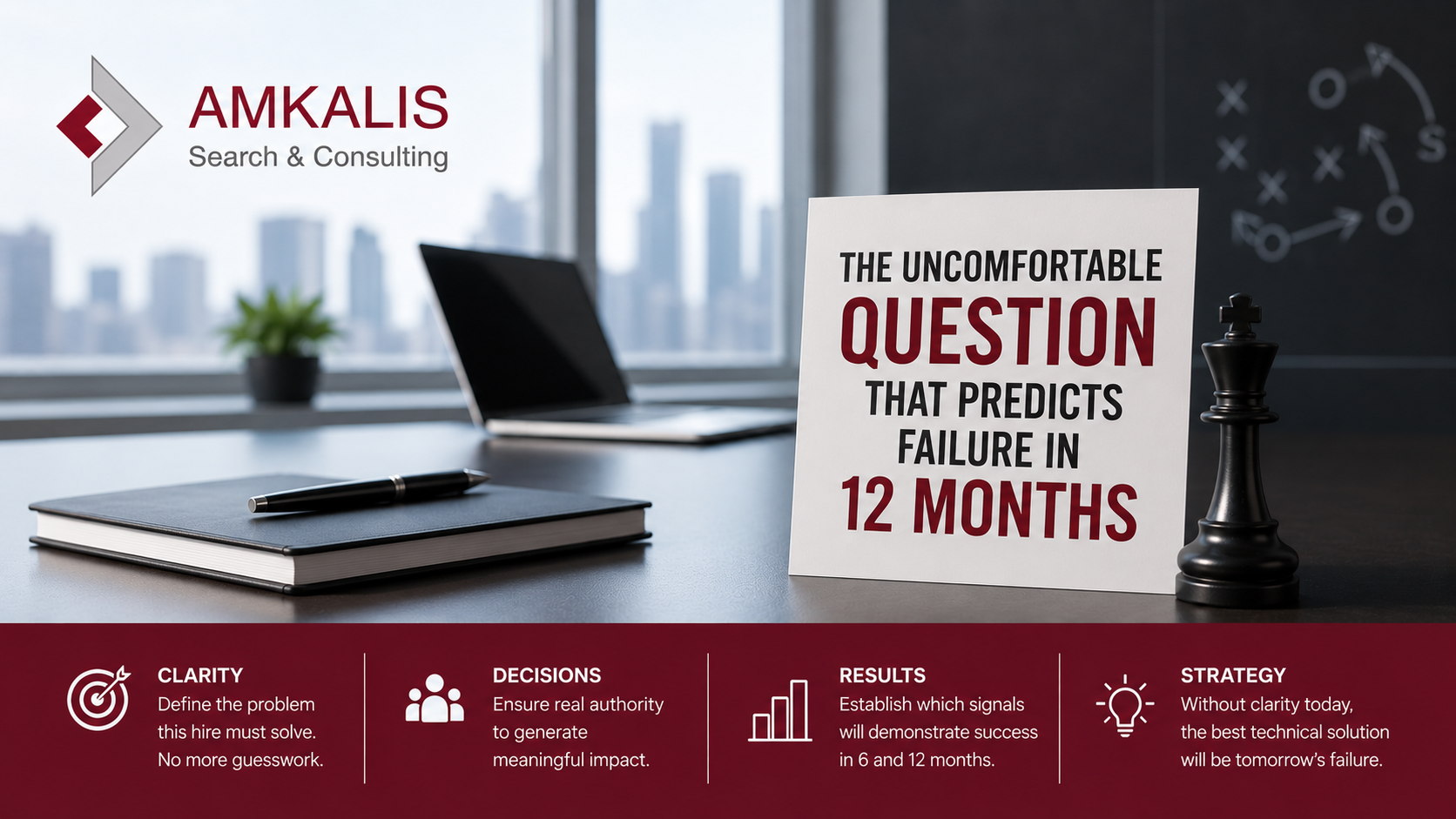
The 12-month question forces clarity
A good search process should not start with a list of requirements.
It should start with three clear answers:
- What decision or problem this person must unlock.
- What real authority they will have to do it.
- Which objective signals will show success after 6 and 12 months.
Without that, the role becomes a wish list.
Very inspiring… not very operational.
AI is accelerating this problem
Organisations are redesigning roles at speed.
Recent reports on employment, AI and talent point in the same direction: technical skills are evolving quickly, but the differentiating value is not only about mastering a specific tool.
It is also about judgement, creativity, resilience, learning ability, communication and leadership.
In other words, hiring is no longer just about “who can do X”.
It is about who can decide, influence and evolve when X changes.
And that cannot be assessed by copying last year’s job description.
My recommendation
Before opening a critical role, ask this question in the decision-making committee:
“If this person leaves in 12 months, would we say the failure was the person, the context or our definition of the role?”
It is uncomfortable. That is why it works.
Because a critical hire does not start when the candidate is interviewed.
It starts when the organisation has the courage to define what it expects, what it allows and what it is willing to change.
Clarity does not guarantee success.
But lack of clarity almost always sends an invoice.
Sources
- World Economic Forum — The Future of Jobs Report 2025
https://www.weforum.org/publications/the-future-of-jobs-report-2025/
- World Economic Forum — The Future of Jobs Report 2025 — Digest
https://www.weforum.org/publications/the-future-of-jobs-report-2025/digest/
- World Economic Forum — Skills outlook — The Future of Jobs Report 2025
https://www.weforum.org/publications/the-future-of-jobs-report-2025/in-full/3-skills-outlook/
- PwC — AI reshapes global labour market into two distinct paths
https://www.pwc.com/gx/en/news-room/press-releases/2026/pwc-2026-ai-jobs-barometer.html
- Gartner — AI Revolution and Cost Pressures Are Two Forces Driving the Top Four Trends for Talent Acquisition in 2026
https://www.gartner.com/en/newsroom/press-releases/2025-10-07-gartner-says-ai-revolution-and-cost-pressures-are-two-forces-driving-the-top-four-trends-for-talent-acquisition-in-2026